Case study
Leading the design of an AI call-assist tool
for fraud detection
A Gen-AI powered tool to reduce cognitive load for fraud analysts and improve detection workflows during live customer calls.
Client
Major UK retail bank
My role
Design Lead
Type
Enterprise Application Design
Duration
6 weeks
AI Product Design
Design Leadership
Human-AI Interaction
Enterprise UX
Workflow Design
SUMMARY
Fraud detection relies heavily on the quality of human judgment under pressure. During customer calls, fraud analysts have to listen carefully, identify suspicious signals, take detailed notes, and summarize outcomes, all in real time.
At one of the UK's largest retail banks, this created a fundamental tension. The more time analysts spent capturing and summarizing information, the less cognitive capacity they had to detect and assess potential fraud.
I led the design of a Gen-AI powered call-assist tool for the Economic Crime Prevention team, aimed at reducing analysts' cognitive load during calls so they could focus on fraud detection. The solution combined AI transcription and summarization with structured outputs designed to integrate into the bank's existing enterprise systems.
The problem
Fraud call handlers had to multitask heavily during customer interactions. They needed to listen actively, identify potential fraud signals, take detailed notes, and summarize each call for downstream processing.
The more analysts focused on documentation, the less capacity they had for the thing that mattered most: detecting fraud.
This created a high cognitive load at a critical moment in the workflow. Manual note-taking and summarization reduced the analyst's ability to focus, increasing the risk of missed signals and inconsistent documentation. From a business perspective, this introduced both operational inefficiency and potential financial risk.
Why this matters
Fraud has a direct financial impact on the organization, so improving detection capability can deliver significant savings, and improving call-handling efficiency reduces operational overhead. The opportunity was not just to automate note-taking, but to protect the quality of human judgment by removing unnecessary cognitive load.
My role
I was the Design Lead, responsible for directing the design effort rather than producing the hands-on design myself. My focus was on setting direction, running the work that fed good design, and getting the team and stakeholders aligned.
Interrogated and shaped the initial brief
Led and directed a design team of two, briefing, delegating, reviewing, and refining their work
Ran initial brainstorming sessions with the team
Planned and ran discovery, which I prioritized because good discovery is what makes the resulting design credible
Mapped the end-to-end analyst journeys
Worked closely with the engagement lead, AI solution experts, and technical leads to shape a feasible solution
Owned client stakeholder relationships and presented the work through show-and-tells
This project is a clear example of where I add the most value as a design leader: shaping direction, running the discovery that grounds the work, aligning teams, and holding quality, rather than owning every design output myself.
Working within constraints
The project operated within a tight set of constraints that shaped every design decision.
Understanding the workflow
Designing for AI-assisted workflows
The goal was not to replace analysts, but to support them. We defined a set of principles to guide the AI-assisted experience:
1
Reduce cognitive load during live calls
2
Support, not replace, human judgement
3
Provide clear visibility into AI outputs
4
Allow users to verify and correct AI-generated content
5
Integrate seamlessly into existing workflows
The solution
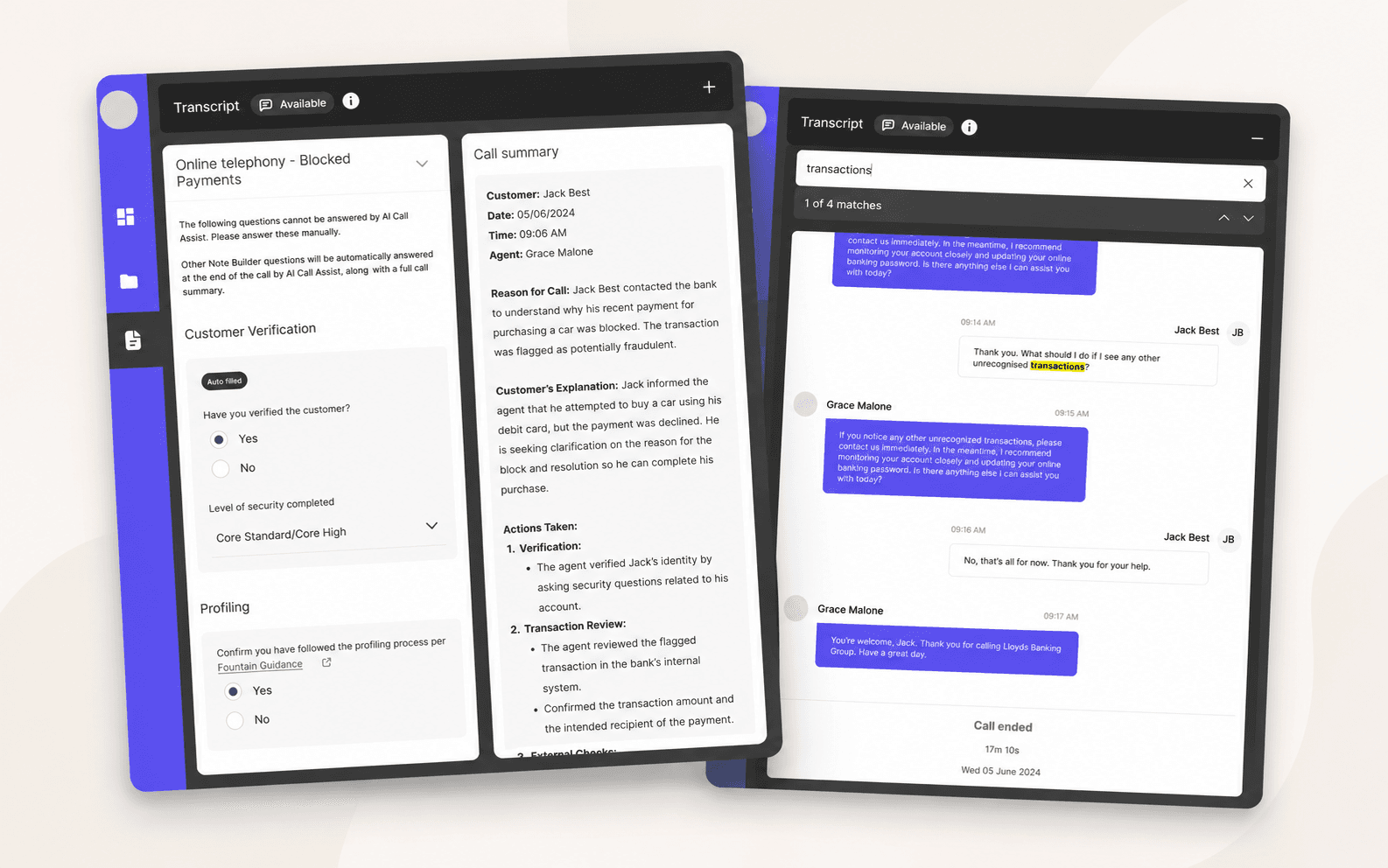
We designed a Gen-AI powered call-assist tool integrated into the bank's fraud dashboard. It included automated transcription of customer calls, AI-generated summaries, a familiar chat-based interface for reviewing conversations, and structured outputs tailored for integration with enterprise tools.
The interface used familiar interaction patterns to reduce the learning curve, so analysts could focus on content rather than interface complexity. Customizable exports based on downstream system requirements were designed to let the tool work across the full fraud operations workflow.
Designing for trust and error
Designing for AI required careful thought about trust. We knew the system would not be perfect, so we designed for transparency and control: users could review and edit AI-generated summaries, the interface made it clear when transcription and summaries were available, and outputs could be validated before being used downstream.
Because real-time transcription was not technically feasible, we designed alternative feedback mechanisms to maintain user confidence, including visual cues to reassure analysts that recording and processing were underway.
Trade-offs
The most significant trade-off was the lack of real-time transcription, which limited in-the-moment validation during calls. We focused instead on post-call workflows and clear feedback to reassure users that processing was underway.
Given the six-week timeline, we prioritized a high-quality, implementable solution over more advanced but less feasible capabilities.
Impact
The designs were well received by stakeholders and were taken forward by the bank's internal development teams, who built and deployed the tool after the design engagement.
The solution was designed to:
Reduced cognitive load during live calls
freeing analysts from manual note-taking so more of their attention could go to detecting fraud signals.
Integrate cleanly into the existing workflows
using familiar patterns and configurable exports rather than adding a separate tool to learn.
Improve documentation consistency
replacing manual summaries with structured AI-generated outputs to strengthen downstream data quality.
Establish a reusable pattern for AI-assisted tooling
that could be extended across fraud and wider financial crime workflows.
That the bank's internal teams took the designs forward into build and deployment is, in itself, a strong signal: the design was clear, credible, and implementable enough to be adopted and delivered.
Reflection
My contribution
Design Leadership
Discovery
Stakeholder alignment
Team direction
Project planning and management
Senior reporting
Collaborators
Engagement Lead
Project direction & client relationship
AI Solution Experts
Technical feasibility & AI architecture
Fraud Operations
Journey design, design feedback
Design Team
UI design & detailed execution
Methods Used
Discovery sessions
Live call listening
User reviews
AI workflow design
Stakeholder presentations
Enterprise integration design
Oscar Choi
© 2026 · Irvine, California